Patient finds relief at Beacon after a decade of searching for answers
 When Kailey Lester was a freshman in high school, she never imagined how drastically her life was about to change. During winter break, she suddenly began vomiting and felt sharp, unrelenting pain deep in her lower abdomen and pelvic area. She hoped it was temporary. She prayed it would pass.
It didn’t.
The pain never left. It followed her for the next 10 years.
“It was like a switch flipped and my life was no longer my own,” she said.
What followed was a decade of searching—month after month of emergency room visits, specialist appointments, uncertainty and frustration. Kailey didn’t know the name of the condition controlling her life. She only knew that she hurt, constantly.
Pain that consumed everything
Pelvic congestion syndrome, or PCS, is caused by enlarged varicose veins in the pelvis. It is a frequently underdiagnosed cause of chronic, dull, aching pelvic pain in women, often resulting from blood pooling in dilated, dysfunctional pelvic veins. Because PCS symptoms can mimic many gynecological conditions, it is frequently missed or misdiagnosed, which can lead to years of unnecessary suffering.
“Pelvic congestion syndrome is one of the most commonly overlooked causes of chronic pelvic pain in women,” said Dr. Michael Ginsburg, interventional radiologist at Beacon Medical Group Interventional Radiology and Vascular Specialists.
The condition is characterized by chronic pain that typically worsens throughout the day and with physical activity. Key symptoms include bloating, heaviness and vulvar and thigh varicose veins. “Many healthcare providers may not recognize the symptoms, leading to misdiagnosis or dismissal of symptoms as psychological,” Dr. Ginsburg said.
For Kailey, the symptoms were debilitating. She had to drop out of high school. Later, even after earning her GED, she had to leave college because the pain became too overwhelming.
She couldn’t sleep. She couldn’t enjoy time with friends. She couldn’t walk without stopping. Her life narrowed to a cycle of pain management and survival.
Two years earlier, an OB-GYN had performed an internal ultrasound that showed varicose veins on her uterus. The finding was never explained to her and never connected to PCS — a detail that would later become a turning point.
Determined to find answers
After years of appointments without progress, Kailey took matters into her own hands. She requested her medical records, studied every detail and searched for clues.
That’s when she discovered pelvic congestion syndrome and learned that interventional radiologists specialize in diagnosing and treating it.
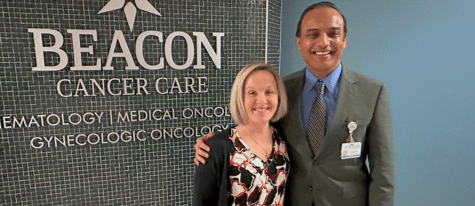
She switched to a new OB-GYN and asked for a referral to a specialist. Her research led her to Dr. Ginsburg, who is known for listening to his patients and providing thoughtful, compassionate care.
Her referral moved quickly. Within a month, Kailey had her first appointment with his team at Beacon Medical Group.
Kailey remembers the consultation clearly.
For the first time in years, she felt truly seen and heard.
The care team reviewed her history carefully. They asked questions. They validated her symptoms. They didn’t dismiss her self‑research.
“He didn’t balk at the idea that I had done research myself,” she said. “He encouraged it. He explained everything so clearly that it finally clicked.”
Imaging confirmed her suspicions: her left ovarian vein was incompetent, creating the venous reflux responsible for her chronic pain.
There was a treatment. And she was a candidate.
A life-changing procedure
Kailey underwent an ovarian vein embolization, a minimally invasive outpatient procedure in which a catheter was inserted through a vein in her neck and guided to the left ovarian vein. Thirteen tiny coils were placed to close the faulty vein and redirect blood flow.
The procedure was performed under twilight anesthesia, and Kailey remembers feeling calm and supported throughout.
What happened next changed everything.
Her pain disappeared almost immediately.
“It was like the angry hornet’s nest in my pelvis was finally gone,” she said.
“Ovarian vein embolization is a safe, highly effective treatment for properly selected patients with pelvic congestion syndrome,” Dr. Ginsburg said. “Though the condition is frequently overlooked due to symptom overlap with many other disorders, accurate diagnosis followed by this minimally invasive procedure can provide dramatic, lasting relief and restore quality of life.”
A new beginning
In the months following the procedure, Kailey’s life dramatically improved. She could cook without taking breaks. She could enjoy her hobbies again. For the first time in years, she began imagining a future—beauty school, a job, independence.
She experienced temporary hormonal changes as her body adjusted to the coils, but the improvement in her quality of life was undeniable.
Kailey credits Dr. Ginsburg, his nurse practitioners and Beacon Health System for the care that transformed her life.
Her message to others walking a similar path is simple and powerful: “It feels like you’re jumping through hoops and never getting answers, but there is a light at the end of the tunnel. Don’t stop advocating for yourself. You deserve your quality of life back. It’s easier to exorcise a demon when you have its name.”
Kailey spent 10 years searching.
Now, she finally has her life back.