Elkhart General patient’s final gift makes him become nation’s oldest liver donor
Every organ donation matters. But in January 2026, one made history.
At 84, Fred Voorde of Elkhart became the oldest liver donor in the United States through Donation After Circulatory Death, or DCD. It’s a process in which doctors recover the organ after life support is withdrawn and the heart stops, rather than after brain death.
Behind the milestone is a man remembered first as a devoted to his wife and kids, then as well-respected Elkhart Community Schools teacher, coach and driving instructor. He served proudly in the United States Army and worked for many years for Elkhart Community Schools as a teacher, driver’s education instructor, and coach. He was a faithful member of St. Vincent de Paul Catholic Church, belonged to the IARA, and the Lions Club of South Daytona. In his retirement, he loved spending time in Ormond Beach, playing cards with friends and family, and watching sports, especially cheering on the Dodgers and Notre Dame.
Fred showed up for people, right up until the end. His story began long before an ordinary day that changed in an instant.
A sudden turn
People recognized Frederick “Fred” Voorde wherever he went. He was also known for simple one-liners that stayed with his family, including, “You never know until you find out.” His daughter Paige said of that phrase, “At the time we laughed, but now it feels exactly right.”
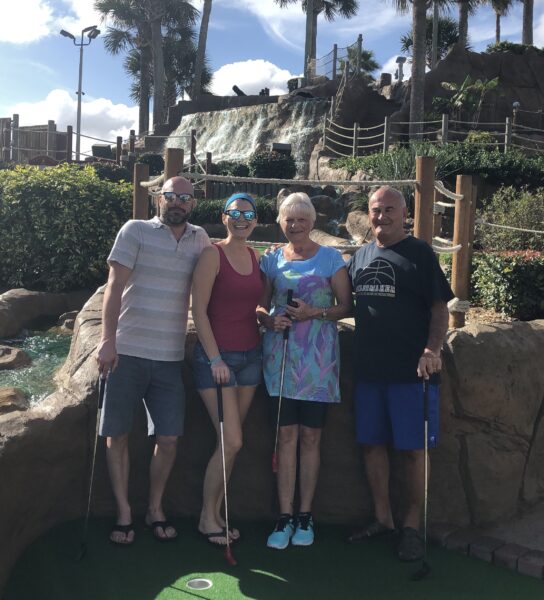
The Fred Voorde family in 2018. From left: Neal (son), Paige (daughter), Sarah and Fred.
Even in his 80s, Fred still saw himself as active and capable. He had friends that he saw regularly, buddies from high school and college. “He never really thought of himself as aging,” Paige said. “He was young at heart and always ready to help.”
Then, an accidental fall down the stairs at home in January 2026 changed everything. His wife, Sarah, did chest compressions while she waited for an ambulance to take Fred to Elkhart General Hospital. When Sarah arrived at Elkhart General, Fred was alert. He told her several times he loved her.
Initially, doctors hoped Fred’s injuries were survivable.
But the next day, after his first surgery, it became clear: The spinal damage was extensive, and Fred would not be able to survive without permanent medical support.
After surgery, he was on a ventilator and couldn’t speak. But Sarah knows now that when he had said he loved her it was his way of telling her goodbye. Fred had a living will, an advanced directive outlining his wishes if he could not speak for himself.
“He didn’t want to live dependent on machines,” Paige said. “We knew what he wanted; we just had to honor it.”
A landmark gift
Knowing that Fred wouldn’t want to survive on machines left one more question for Sarah and Paige. Could organ donation still help save someone’s life?
Until recently, doctors wouldn’t consider someone Fred’s age as an organ donor. But advances in medicine are changing that.
The Indiana Donor Network removed the upper age limit for death after circulatory death donors due to advances such as normothermic regional perfusion. It circulates warm, oxygenated blood after death, preserving organs longer and expanding donor eligibility.
A donor’s journey
Once Paige and Sarah agreed to organ donation, doctors determined Fred’s liver was viable. What followed was a deeply coordinated effort between doctors at Elkhart General Hospital and the team from Indiana Donor Network.
Hospitals notify donor networks when a patient is near death, triggering evaluation and coordination for potential donation. The nursing staff initiates contact with Indiana Donor Network and provides clinical updates. Once a patient is deemed suitable for donation, the Indiana Donor Network sends a team onsite.
Amanda Kuczmanski, hospital liaison, Indiana Donor Network
Paige remembers the scale of the effort. “There were so many people,” she said, “and everything was so organized and intentional.”
“It truly takes a village to make organ donation possible,” said Amanda Kuczmanski, hospital liaison for the Indiana Donor Network. Amanda said the Indiana Donor Network staff includes team coordinators, supervisors, surgeons and liaisons. Throughout the entire process, they coordinate communication between the hospital and Indiana Donor Network while ensuring support of both the hospital and donor family.
Despite the complexity, the experience felt seamless to Fred’s family. “We felt seen,” Paige said. “We didn’t feel alone.”
The final good-bye
When the time came to take Fred off life supporting machines, Paige and Sarah sat beside Fred, talking to him, reassuring him and sharing memories. “We told him it was okay. That we love him. That we were there with him.”
A small group stood by in the Elkhart General waiting room for Sarah and Paige. Close friends of the women offered support, and Fred’s life-long friends were able to say a final goodbye to a man they all loved.
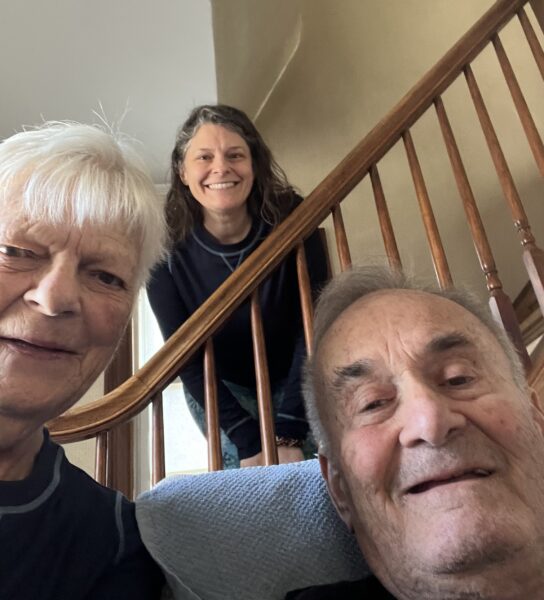
Sarah, Paige and Fred Voorde in 2025.
After about an hour and a half, Fred passed peacefully.
Almost immediately, the next step began.
Amanda said a liver can remain outside the body for up to 12 hours on a perfusion device, keeping it viable for transplant over longer distances and longer periods of time.
“At this time, Fred is the oldest DCD liver donor ever in the United States,” Amanda said. “As perfusion technology and NRP (Normothermic Regional Perfusion) devices continue to evolve, we expect more stories like this to emerge.”
For Paige, the news was astonishing.
“It just shows, you never know until you find out.”
A lasting legacy
Fred had already said “yes” to organ donation at the Bureau of Motor Vehicles, which allowed his family to support his wishes rather than wonder what he would have wanted.
His liver went to a woman in her 70s.
“He saved a life through his final act — something that may not have happened if he had assumed he was too old to be a donor,” Amanda said. “There is no age restriction for donation, and we encourage anyone of any age or health background to say ‘yes’ to being a donor.”
The recipient continues to do well post-transplant as of the end of March 2026. To Paige, the meaning of this act and connection is still sinking in.
“I hope it gives her more time,” Paige said. “The decision has brought us peace through our grief, knowing Dad could still help someone.”