A closer look at a heart concern led Beacon’s care teams to a life-saving lung cancer discovery
Beacon Health System is on the road to completing its 500th MONARCH® Robotic Bronchoscopy procedure in August 2026. It marks more than a technology milestone. It represents 500 opportunities to find answers and diagnose cancer earlier.
And for MONARCH procedure number 382? It helped save Carrie’s life.
A clinical social worker who has spent years helping others through difficult circumstances, Carrie never imagined she would become a patient in need of that same support. But last winter, a nagging pain during a workout led to a series of tests, an unexpected discovery and ultimately an early lung cancer diagnosis that changed the course of her future.
Her journey highlights what can happen when patients speak up, providers listen and an entire team works together to move quickly from finding a problem to finding a solution.
A strange feeling that wouldn’t go away
 The first sign that something wasn’t right came at the gym in the winter of 2025. Carrie was on a treadmill with a friend when she noticed an unusual sensation deep in the left side of her chest. It wasn’t severe pain, but it didn’t feel normal either. The sensation returned several times over the following weeks.
At first, she brushed it off. “I thought maybe I pulled a muscle or something,” she said. “But it kept happening.”
Because her father had suffered a heart attack before age 50, the symptoms caught her attention. As she was approaching that same milestone birthday herself, cardiac problems seemed like the most logical explanation.
She scheduled an appointment with her primary care physician, Laura Munkel, MD, at Beacon Medical Group Goshen Family Medicine Center.
An in-office EKG looked perfect. Dr. Munkel could have stopped there. Instead, she listened to Carrie’s concerns and looked deeper.

Laura Munkel, MD
“I trust when she feels that something was not right,” Dr. Munkel said. “Even though her EKG was normal, I wanted to pursue the issue further due to her symptoms. I know my patients and just felt there was more to Carrie’s health concerns.”
Additional testing followed, including a treadmill stress test that Carrie unexpectedly failed. Looking back, she sees that moment differently now. “If I would’ve passed it, they probably wouldn’t have gone any further,” she said. “I think it was divine intervention.”
When Carrie didn’t pass her stress test, Dr. Munkel coordinated with cardiology for a follow-up as soon as possible. “As her primary care physician, I feel it is my responsibility to assist in ‘what happens next,’ always keeping in mind my patient’s point of view.”
The failed stress test led to a coronary CT angiogram in January 2026. The results showed mild non-obstructive coronary artery disease, which had a treatment plan of cardiac catheterization or observation. But the scan also revealed something no one was looking for: a suspicious mass in her left lung.
The news she never expected
The call came quickly. Within days, Carrie learned that while her heart could take a wait-and-see approach, she needed a pulmonologist to evaluate her lungs for signs of cancer.
Lung cancer had never crossed her mind. Carrie had never smoked or vaped. There was no family history of lung cancer. She didn’t use hazardous chemicals at work. “I was completely shocked,” Carrie said. “If there was anything wrong, I thought it would be my heart.”
Like so many, Carrie assumed lung cancer affected smokers. According to the Centers for Disease Control and Prevention, about 10% to 20% of lung cancers diagnosed each year in the U.S. are in people who never smoked.
A doctor who took time
Just days after the finding, Carrie met with pulmonologist Muhammad Saeed, MD. The appointment immediately felt different.
Dr. Saeed reviewed the images with Carrie and her husband Keith, explained exactly what he was seeing and laid out her options. Most importantly, he made her feel like an active participant in the decision-making process. “He was very kind and compassionate and very present in the room,” Carrie said.
Dr. Saeed understands the anxiety his patients experience while navigating the path to a diagnosis.
“The uncertainty can be truly daunting,” Dr. Saeed said. As he explains imaging and procedures in detail, he ensures each patient has the opportunity to ask questions and feel heard. “I remember my conversation with Carrie well. As a never-smoker, her risk profile differed from many of our patients, and she came prepared. She had done her homework and asked all the right questions.”
Carrie had a dedicated chest CT on January 9. Immediately after the scan, Dr. Saeed began to collaborate with the Beacon Interventional Radiology team. Through this multidisciplinary approach, the team reached a consensus the same day. The team agreed that biopsy using the minimally invasive MONARCH® Robotic Bronchoscopy was the best next step.

Muhammad Saeed, MD
“The nodule in question was located in an area that would have been difficult to reach with bronchoscopic technology available before the advent of robotic bronchoscopy,” Dr. Saeed said. “While it could have been reached with CT-guided transthoracic biopsy, that approach carries a higher complication rate.”
Carrie had never undergone anesthesia before and was nervous about the recommendation for robotic-assisted surgery. Still, something about Dr. Saeed’s approach helped her trust the process: rather than telling her what to do, he made it clear the decision was hers.
That respect made an impression. “He wasn’t a doctor trying to sell a procedure,” Carrie said. “I believed he was genuinely worried about me.”
Robotic surgery as a safe diagnostic tool
In April 2025, Johnson & Johnson, maker of the MONARCH® Platform, published a study that showed clinicians were able to reach small and peripherally located lung nodules in more than 98% of cases with the MONARCH Platform and biopsy them with a safety profile comparable to non-robotic bronchoscopy techniques.
Robotic technology enables physicians to navigate deeper into the lungs while remaining minimally invasive for the patient with just a few small incisions. Because of this, patients experience less pain, faster recovery, quicker return to work and better cosmetic results with little scarring.
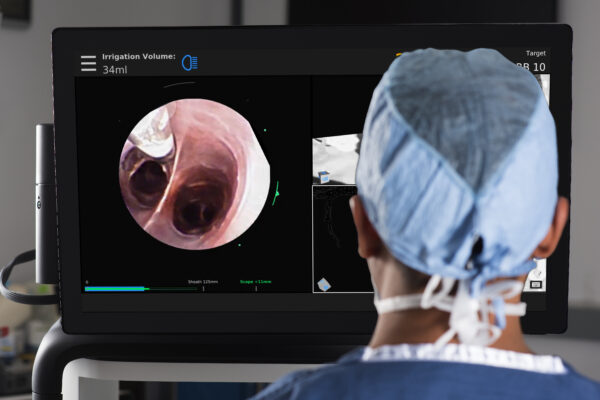
Physician perspective of the Monarch Platform.
And for doctors, robotic surgery provides a magnified, 3D view of the surgical site and helps the surgeon operate with precision, flexibility and control. Physicians maintain full control throughout the procedure; the robot serves as a sophisticated guidance and navigation tool.
Approaching 500 procedures for a community-based healthcare system like Beacon is a meaningful milestone. It reflects multiple components working in unison — clinical expertise, technology, coordination and team commitment — all focused on one goal: outstanding care.
“At every step, we ask ourselves not just whether we can diagnose, but whether we are walking alongside our patients through their journey,” Dr. Saeed said. “That requires listening, explaining and bringing genuine care to what can otherwise feel like a purely mechanical process.”
Elkhart General Hospital launched navigational bronchoscopy in 2022, and each year since has expanded clinical capacity to meet the growing needs of the community.
This coordination happens through Beacon’s virtual Lung Nodule Clinic, a multidisciplinary platform where advanced bronchoscopists, pulmonary nurse practitioners, interventional radiologists and cardiothoracic surgeons meet weekly at Elkhart General, alongside the hospital’s lung nodule coordinator, nodule navigator, and oncology navigator, to review cases. Since the program was launched in 2022, more than 1,000 cases have been reviewed — including roughly 300 in 2025 alone.
The procedure that changed everything
When procedure day finally arrived on January 26, Carrie was terrified. She remembers telling her husband she changed her mind and wanted to leave. But instead, she met a team that understood her fears.
She remembers Dr. Saeed stopping by to reassure her before the procedure. She remembers the anesthesiologist’s friendliness and humor. She remembers feeling cared for.
The procedure lasted about 90 minutes. After a few hours in recovery, Carrie was on her way home. It was the waiting afterward that felt much longer.
Dr. Saeed said obtaining the diagnosis is only the beginning. “Our true strength at Beacon lies in how we coordinate care after the procedure. Our team works across specialties in the thoracic oncology pathway — monitoring key metrics like time to diagnosis and time to treatment — to ensure our patients move seamlessly from diagnosis to the next appropriate step without delay.”
It only took a couple of days for Carrie to get a call from Dr. Saeed’s nurse with a diagnosis: The findings were highly suspicious for adenocarcinoma.
Adenocarcinoma is the most common form of lung cancer. The diagnosis accounted for the pain she felt when working out. “It was gut-wrenching and scary,” Carrie said. “You start thinking, this is going to be a lot.” The word cancer changes everything.
Yet almost immediately, there was a plan with a multidisciplinary team at Beacon. Her nurse explained next steps, including a PET scan and a brain MRI to see if the cancer had spread. This early testing helped doctors identify Carrie’s cancer at a highly treatable stage. Carrie was also scheduled to consult with a thoracic surgeon.
Finding strength in difficult days

Carrie’s cancer diagnosis arrived during one of the hardest seasons of her life. In the middle of everything, her father unexpectedly passed away. As her family grieved, she was simultaneously navigating scans, appointments, and decisions about cancer treatment.
Through it all, Carrie leaned on her faith, her husband and family, and her natural tendency to focus on action. She also worked hard to maintain perspective. A friend’s young grandson had recently died from cancer, and that experience stayed with her.
“There is no ‘poor me’ here,” Carrie said. “I’m 50 years old. I’ve been a wife. I’ve been a mom. I’ve had a career. I have a lot to be thankful for.”
A collaborative approach to care
On March 17, surgeons removed Carrie’s tumor, part of her left lung and nearby lymph nodes using a minimally invasive approach. Final pathology brought encouraging news. Neither the PET scan nor the brain MRI showed evidence of spread, and the lymph nodes were cancer-free.
Doctors diagnosed Carrie with Stage 1B cancer, meaning the tumor remained localized and had not spread to distant parts of the body. In contrast, many lung cancer patients receive a lung cancer diagnosis at Stage 3 or Stage 4.
On one Sunday, as Carrie navigated questions about oncology care, she sent him a message through the Beacon Patient Portal. She expected a response days later, instead Dr. Saeed replied to Carrie the same day.
“He had me scheduled for tumor board review and had already referred me to oncology,” she said. Moments like that reassured her that she wasn’t facing the journey alone.
“I didn’t feel like a patient in a stack of files,” she said. “I felt like he knew exactly what was going on with me.”
A new perspective
Today, Carrie manages her lung cancer with Tagrisso, a targeted pill taken once a day for non-small cell lung cancer. She’ll take Tagrisso for the next three years without needing radiation. The convenience of an at-home treatment helps her stay focused on living her life, not planning around treatment visits. She has returned to work full-time, resumed her regular gym routine and enjoys the same active lifestyle she had before surgery.
Looking back, Carrie sees a series of people whose decisions changed the course of her life. A primary care physician who listened when something didn’t feel right. A screening process that kept moving forward despite normal results. A pulmonologist who treated her with honesty, compassion and respect. Teams across specialties who communicated quickly and worked together.
“We’ve stayed in close communication since her procedure,” Dr. Saeed said. “And I’m grateful for that relationship.”
Life feels normal again. But not quite the same. Carrie notices more of the smaller things now. Time with family feels more meaningful. Ordinary moments feel more valuable.
Most of all, she sees how easily the outcome could have been different. “If Dr. Munkel had stopped after the EKG, I probably would’ve stopped too,” she said.
Today, Carrie’s message for others is simple: Pay attention to your body, speak up when something feels wrong and don’t assume lung cancer only happens to smokers.
Because sometimes the test ordered for one problem uncovers another. And sometimes that unexpected discovery becomes the very thing that saves your life.