A second chance: How rapid CPR, expert heart care and teamwork saved Ryan Hunt’s life
On the morning of April 19, 2025, Ryan Hunt’s day started like any other.
The 46-year-old father from South Bend, Indiana, had worked out, felt healthy and was getting ready to run errands before Easter. Cardiac arrest was the last thing on his mind.
Within minutes, everything changed.
Ryan will tell you a dedicated team cared for him during the most critical moments of his life — from the EMTs to the doctors and nurses at Beacon’s Emergency Department at Memorial Hospital of South Bend. And along the way, there were minor miracles that changed his odds of survival.
Heart attack symptoms on an ordinary Saturday
As Ryan got ready in his bathroom that April morning, he suddenly felt pain throughout his body along with numbness in his arms and legs. Even though Ryan’s job is to work with hospitals and healthcare systems to help train teams in high-quality CPR, he didn’t immediately believe the symptoms pointed to a serious heart problem. He was young, worked out every day and ate healthy foods.
“It came very quickly,” Ryan said. “I was trying to rationalize it away. I thought maybe I had pulled a muscle or pinched a nerve while working out.”
Ryan first felt pain throughout his body. Then, he had numbness in all his limbs. Within a minute, Ryan was on the floor of his bathroom unable to do anything but speak in a weak voice.
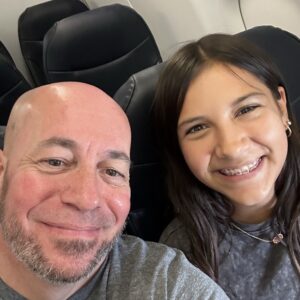
Ryan Hunt and daughter Addy.
“A reasonable person would have said ‘I should have called 911 as soon as I was experiencing the symptoms.’ But by the time I got to the point where I thought, ‘I need to make a call or ask for help,’ it was too late for me to physically do it because of the numbness and tingling in my hands,” Ryan said. “I wouldn’t have been able to dial an actual phone.”
Fortunately, Ryan wasn’t home alone. His then 15-year-old daughter, Addison (Addy), checked on him after hearing him struggle and found him on the bathroom floor. Minor miracle #1: Addy found him.
Ryan told Addy to call his sister, Sarah Miller, a cardiac night charge nurse at Memorial Hospital. Despite having just finished a night shift, Sarah answered the phone.
“Addy explained what was happening, and my sister knew right away this wasn’t a workout injury,” Ryan said. “She told us, ‘You need to call 911 right now.'”
Minor miracle #2: Sarah answered.
A father’s greatest fear
Ryan remembers nearly everything that happened next.
Ryan lived only three miles from the nearest fire station. The ambulance was at his house within minutes. Minor miracle #3: EMS was nearby.
He remembers seeing his daughter’s face. “The last person I saw before leaving my house was my daughter,” Ryan said. “I didn’t want to leave her. I didn’t want to orphan her.”
Ryan felt at peace with most parts of his life, except for one: Addy. “There was the feeling that I could be leaving her and I hadn’t truly prepared her for life.”
He remembers the ambulance ride. He remembers the faces of the emergency responders. Ryan vividly remembers thinking about the cardiac arrest statistics he knew from his job as a CPR trainer.
Ryan knew that if he went into cardiac arrest before reaching the hospital, his chance of survival was about 9%. He knew if he had a cardiac arrest in the hospital, his survival would increase to 25%. Regardless of where he had a cardiac arrest, Ryan knew three out of four patients didn’t make it.
“I remember thinking, ‘If this goes from a heart attack to worse, things are stacked against me,’” Ryan said.
What is a cardiac arrest?
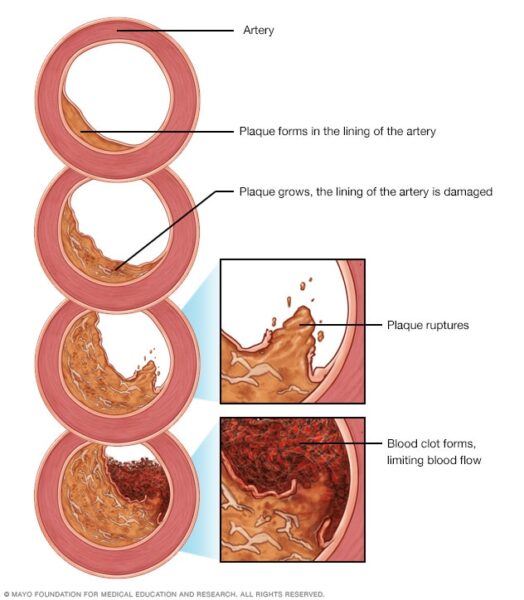
Plaque and blood clots can reduce blood flow through an artery.
Cardiac arrest and heart attacks are two separate events, though some people mistakenly use the terms interchangeably.
A heart attack happens when a blockage reduces or stops blood flow to the heart. The blockage is usually due to a buildup of fat, cholesterol and other substances in the heart (coronary) arteries.
Cardiac arrest is an electrical malfunction where the heart stops beating unexpectedly. With its pumping action disrupted, the heart cannot pump blood to the brain, lungs and other organs. Within seconds, a person becomes unresponsive and stops breathing or is only gasping for breath. Death can occur within minutes if the person does not receive treatment such as CPR or an electrical shock through an Automated External Defibrillator (AED).
Most heart attacks won’t lead to cardiac arrest. But when cardiac arrest occurs, heart attacks are a common cause.
Know the signs of a heart attack
From heart attack to cardiac arrest
Ryan lives just a few miles from Memorial Hospital. He made it to the hospital before suffering cardiac arrest, greatly improving his chances of survival. Minor miracle #4: Memorial was minutes away.
He remembers arriving at the Memorial Hospital Emergency Department and seeing a lot of concern on the faces of the staff. A physician explained to Ryan that he was having a heart attack.
Then everything stopped. Ryan suffered cardiac arrest.
Moments later, he regained consciousness while Beacon caregivers were performing CPR. “I came back in the middle of chest compressions, their hands were on my chest,” Ryan said. “I knew exactly what was happening.”
Ryan attributes his remarkable memory of these events to the staff at Beacon. “I know they were delivering high-quality CPR, and they were feeding my brain enough oxygen that I didn’t lose those functionalities.”
A team prepared to save a life
As his heart sprang back to life, Ryan tried to sit up and tell them that he was okay, that he just needed to catch his breath.
Ryan assessed what was going on around him. He still had the defibrillator pads attached to his chest. Later, he read the hospital notes and learned that his care team made multiple attempts to restore his heart rhythm.
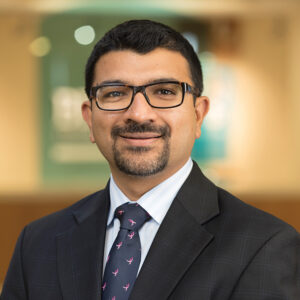
Mayank Mittal, MD
Interventional Cardiologist and Memorial Cardiac Cath Lab Director
According to Mayank Mittal, MD, an interventional cardiologist and the Memorial Cardiac Cath Lab Director, Ryan had the most severe kind of heart attack, the one in which the artery suddenly closed due to rupture of plaque made up of cholesterol. This is an unpredictable event and sometimes even seemingly normal healthy people can have coronary artery disease that is stable — until it is not.
This triggered Ryan to experience the deadliest form of heart rhythm abnormality caused by ventricular arrhythmias. This is often a fatal event if not treated with cardioversion within seconds.
Fortunately, Ryan received expert care and resuscitation right when he needed it and CPR and shock brought him back to life. His EKG was still showing signs of heart attack and Dr. Mittal’s heart team had 90 minutes to open the 100% closed artery. It was a race against time to save his heart muscle and save his life.
Ryan’s care team rushed him to the Memorial Hospital Cardiac Cath Lab, where Dr. Mittal opened the artery within minutes. Using a minimally invasive procedure, Dr. Mittal restored flow in Ryan’s heart and placed an artificial heart pump from his artery in his leg — allowing his heart to rest and recover.
Dr. Mittal explained that research shows that when someone has a massive heart attack and their heart stops, they only have a 20% chance of surviving. Because of the expeditious and expert care provided by the Beacon doctors and nurses, Ryan not only survived this catastrophe but also completely recovered his heart pump function. “This is nothing short of a miracle,” Dr. Mittal said. “It would not have been possible without the coordinated care and advanced medical care that Ryan received at Beacon.”
More than one lifesaver
As Ryan recovered, he learned just how many people had come together to save his life.
“It wasn’t one person,” he said. “It was a team.”
Ryan credits the coordinated efforts of emergency responders, emergency department staff, nurses, physicians and cardiac specialists for giving him a second chance.
“I know how busy hospitals are. I know how many demands healthcare workers face every day,” he said. “But in my greatest time of need, an entire care team rallied around me and saved my life.”
And all those minor miracles? His daughter checked on him at exactly the right time. His sister recognized the symptoms. Emergency responders arrived quickly. Memorial Hospital was only minutes away.
“All of those things greatly contributed to me still being here today,” he said.
A genetic risk no one knew about
In the weeks after his cardiac arrest, Ryan and his family learned something surprising.
When Dr. Mittal ran Ryan’s genetic testing, it identified a mutation affecting the LDL receptor pathway — the same pathway responsible for familial hypercholesterolemia, one of the most common inherited cholesterol disorders, affecting roughly 1 in 250 people.
“What makes this condition so dangerous is that it doesn’t always show up on a routine lipid panel,” Dr. Mittal said. “A patient’s total cholesterol or LDL number can look borderline normal, even while plaque has been building silently in the arteries for years.” That’s what might have happened with Ryan, because nothing in his medical history flagged him as high-risk until his heart said otherwise.
Once there was a diagnosis, Dr. Mittal treated Ryan with medication and offered genetic screenings to Ryan’s family. “Our hope was that if we can identify which family members are affected by these genes,” said Dr. Mittal, “perhaps we can start them on cholesterol-lowering therapy before they ever have a cardiac event. That’s the real value of catching this — it turns one person’s emergency into an entire family’s early warning system.”
As a result, several of Ryan’s relatives began treatment for familial hypercholesterolemia.
“What came out of all of this is awareness,” Ryan said. “Now our family knows there’s a genetic issue that needs to be monitored and managed.”
Recovery after cardiac arrest
Although Ryan avoided significant physical, brain or nerve damage, recovery still required patience. The greatest challenge was rebuilding confidence in his body.
“You lose trust in yourself a little bit,” he said. “You wonder what your limits are and how hard you can push.”
Under the guidance of Dr. Mittal, Ryan slowly returned to exercise, beginning with short workouts and gradually increasing his activity level. Eventually, he noticed small signs that he was improving.
“I wasn’t exhausted all the time anymore,” he said. “My energy was coming back. I could tell my body was healing.”
His family played an important role in that process. After leaving the hospital, Ryan stayed with his parents while he recovered, and Sarah helped him understand every test, medication and milestone along the way.
The gift of time
Today, Ryan has returned to work, resumed his fitness routine and continues to stay active with his daughter while following his care plan. But, more than a year later, Ryan still thinks often about what happened and about those four minor miracles.
The experience of being a cardiac arrest survivor changed him, but it also deepened his gratitude. After all, on a busy Saturday before Easter, a team of highly trained caregivers showed up ready to do their jobs. Their skill, preparation and commitment gave a father a second chance.
“If I could thank them,” Ryan said, “I would thank them for taking their training seriously, for showing up and doing their jobs well. They gave me everything they had, and because of that, I’m still here.”
Ryan shares his experience with healthcare professionals across the country. The following year, Ryan returned to Memorial Hospital of South Bend, teaching the educators and the staff about new equipment that will help deliver high-quality CPR and improve resuscitation outcomes.
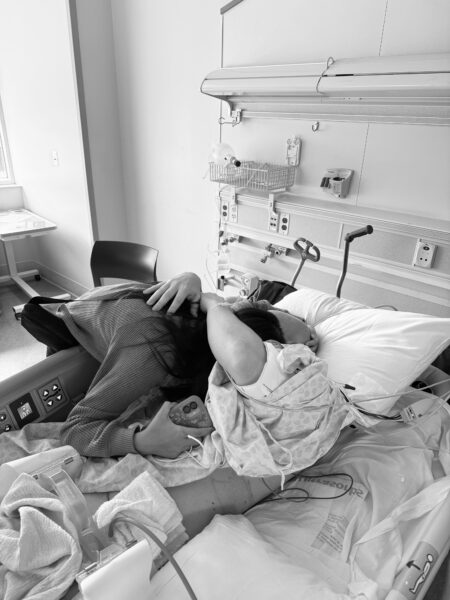
Addy hugging her father, Ryan Hunt, the day after his cardiac arrest in 2025.
Before becoming a patient, Ryan viewed CPR training as preparation to save someone else’s life. Now he understands it differently.
“You may be putting your hands on one person during CPR,” he said. “But you’re impacting their children, their parents, their spouse and their friends. You’re touching many lives.”
One photo has become central to that message. After Ryan regained consciousness, one of his sisters captured a moment between him and Addy in his hospital room.
“I share that picture with those I train because what people are really giving isn’t just life,” Ryan said. “They’re giving the gift of time.”
Time to watch a daughter grow up. Time to be with family. Time to experience everyday moments that once seemed guaranteed.
And what excites him most about the future? The answer comes easily.
“Watching my daughter grow,” he said. “Knowing that I get to do that. That’s the greatest gift of all.”