Campfire safety: Preventing burns and knowing what to do if one happens
Campfires are a highlight of many summer experiences whether it’s roasting marshmallows at overnight camp, gathering at day camp or relaxing with family at a campsite.
They’re also one of the most common sources of injury during camping season.

Rachel Kratzer, NP, MedPoint Urgent Care Main Street
“Burns related to campfires are something we see every summer. And in many cases, they happen very quickly, often when someone doesn’t realize how hot a surface still is,” said Rachel Kratzer, NP, family medicine nurse practitioner at MedPoint Urgent Care Main Street.
While open flames are the most obvious risk, many burns actually come from indirect contact. Metal grates, fire rings, cooking tools and even nearby rocks can retain heat long after the fire looks like it has died down.
“That’s one of the biggest surprises for families,” Rachel said. “Something that doesn’t look hot can still cause a significant burn.”
Prevention often comes down to awareness and a few simple habits.
Keeping a safe distance, especially for younger children, can help reduce risk. Some providers recommend a simple rule of thumb: staying at least three feet away from the fire unless supervised.
Loose clothing, running near the fire pit and reaching over flames are other common causes of injury, particularly in group settings where distractions are high.
For families and camp staff, close supervision is key, especially in the evening when visibility is lower and fatigue can set in.
Even with precautions, burns can still happen. Knowing what to do in those first moments can make a meaningful difference.
“The first step is to cool the burn under running water,” Rachel said. “That helps stop the burning process and can reduce damage to the skin.”
Cool water, not ice, should be used for at least several minutes. Ice can further damage the skin and should be avoided.
After cooling, the area can be loosely covered with a clean, dry dressing to protect it.
From there, the next step is deciding whether additional care is needed.
Mild burns may cause redness and discomfort but can often be managed at home. However, more serious burns require medical evaluation.
“If you’re seeing blistering, significant pain or the burn is in a sensitive area like the hands, face or feet, it’s a good idea to have it looked at,” Rachel said.
Larger burns or those that continue to worsen should also be evaluated promptly.
In more severe situations, such as burns that appear deep, involve a large area or are accompanied by other symptoms, emergency care may be necessary.
For most families, these situations are uncommon. But taking a few precautions and knowing how to respond can help keep a memorable part of camping from becoming a medical concern.
“Campfires are meant to be enjoyed,” Rachel added. “A little awareness goes a long way in keeping everyone safe.”
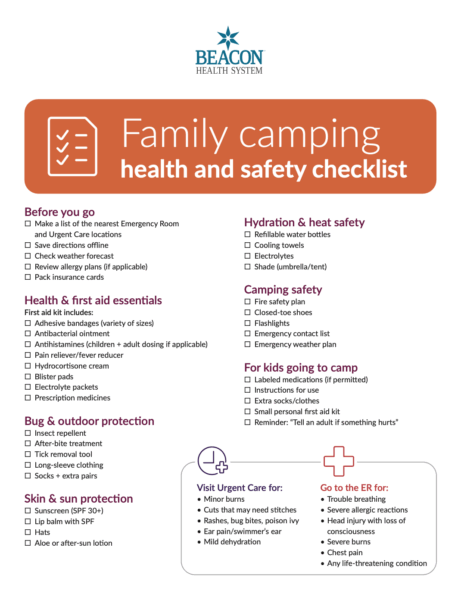 Free download!
Before heading to camp or out on a family trip, most of us pack the basics: clothes, snacks, gear. But one of the most important things to bring is something you hope you won’t need: a well-stocked first-aid kit. Get your free family camping health and safety checklist.