Nurses Month: Meet the Beacon nurses who bring comfort to every patient they serve
Connection is at the heart of nursing. It’s what transforms a moment of care into something a patient carries with them long after they’ve gone home. It’s the reason a nurse remembers a name, sits a moment longer or offers a word that arrives at exactly the right time.
At Beacon, our nurses deliver outstanding care and bring compassion into every room they enter. They see the fear behind the question, the person behind the diagnosis and the family behind the patient, and in doing so, they always connect with heart.
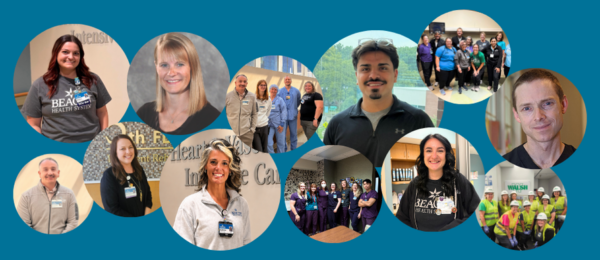
Our remarkable nurses make Beacon what it is. Different paths, different specialties, different hospitals, but one shared commitment to the patients we serve. Starting today, National Nurses Day, and every day through the month of May, we will share a nurse’s journey.
26 nurses. 26 journeys. 26 stories that will stay with you.
Join us right here as we celebrate the nurses behind the moments that matter most. Follow along, share their stories and help us honor the nurses who bring our mission to life every single day.
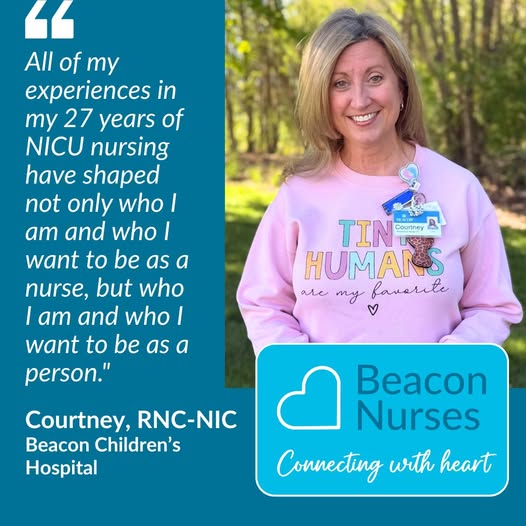
Courtney Kubik, RNC-NIC
Beacon’s Children’s Hospital
Courtney Kubik has cared for some of the tiniest, most fragile babies to ever come through the NICU at Beacon Children’s Hospital. But Audrey, born in 2021 weighing just 11 ounces, holds a place all her own.
As one of Audrey’s primary nurses, Courtney followed her through months of fights and setbacks, breakthroughs and hard days, caring for the baby and the family beside her. “Watching her fight and resilience on a weekly basis for months in our unit and watching her where she is today is really what NICU nursing is all about. She and her family hold a very special place in my heart.”
And she holds a very special place in theirs. “Courtney stood by our side in what felt like the darkest of times, and we can never thank her enough for everything she has done for Audrey and our family. She’s the best.”
Courtney did not always know she wanted to be a nurse. She was a junior at Indiana University, headed down a different path, when she realized it wasn’t right. She made the switch to nursing, a daunting decision that meant more time in school.
While she knew she was moving in the right direction, no single specialty called to her. Then came a clinical rotation with a day of observation in the NICU. “It was really a world that I never even knew existed. I knew after that one day that the NICU was exactly where I wanted to be.”
She knows she is in the right place at Beacon Children’s Hospital when a premature baby arrives, when a newborn is sick, when a situation turns emergent and everything she knows is needed at once. “Those are the days that I feel like I make a difference.”
In the NICU, connecting with heart means putting a terrified family at ease. It means praying with them, sitting with them, being present when their world has been turned upside down by something they never saw coming.
Nursing has taught her the unexpectedness and fragility of life. She carries that with her everywhere. “All of my experiences in my 27 years of NICU nursing have shaped not only who I am and who I want to be as a nurse, but who I am and who I want to be as a person.”
Heather Rex, BSN, RN
Beacon Medical Group
Heather Rex knew she wanted to be a nurse before she had any reason to.
No close family members in the profession. No defining moment that pointed her there. Just a high school student thinking through her future and arriving at the same answer every time. There was no better job than one centered on caring for people every day.
Nursing felt like the right balance of knowledge, skill and the opportunity to truly impact others.
Thirteen years later, and now a cardiovascular specialty nurse with Beacon Medical Group, she still feels it. Not always in dramatic moments, but in the ones that happen between the bigger things. Easing a patient’s anxiety. Reducing fear. Making someone feel heard. “Those connections are powerful and serve as reminders of our shared humanity.”
Heather has been present as patients have passed away. She has helped patients share devastating news with their families. She has sat in the darkest moments of people’s lives and tried to be, as she puts it, a ray of light. “While we may not always be able to fix or heal them, we can still be a source of comfort that helps guide them forward. These experiences reinforce both the responsibility and the privilege I have to show compassion and dignity in every interaction.”
For Heather, connecting with heart means treating every patient the way she would want her own family treated. Listening. Understanding. Acting with empathy.
On the hardest days she returns to Colossians 3:23. “Whatever you do, work at it with all your heart, as working for the Lord, not for human masters.” She reminds herself who she is ultimately working for. “What a privilege it is to be His hands and feet here on Earth.”
To anyone considering nursing, Heather is honest. “It will be physically and emotionally exhausting at times. But the reward — knowing you have made a meaningful difference — is well worth it.”
Melissa Grant, RN
Beacon Medical Group
When Melissa Grant was a little girl, her Nana had surgery and Melissa stayed to help care for her. She helped her to the bathroom. Managed her medications. Handled what needed handling. Melissa did not know it then, but she was already becoming a nurse.
That instinct has carried her through a career built around one of nursing’s most meaningful relationships — the annual wellness visit. Year after year, the same patients come back to see Melissa. She knows their needs, their homes, their struggles. She watches for changes. She helps them get what they need to stay in their homes.
A familiar face, she says, means everything to someone getting older. “I have patients who schedule with me year after year. Getting to know them and their needs, seeing them year after year gives me a perspective on if things are getting harder for them or if there are changes in their health.”
She has always loved working with the geriatric population. In nursing school, she cared for elderly patients in a nursing home and found something she did not expect. “They were always thankful for anything. Even just listening.” She learns from them as much as they learn from her.
One patient stays with her. He was seriously ill and came to her with his family, needing help managing his medications. Melissa took the time and explained everything, setting things up carefully. After he passed, his family came back. They wanted her to know how grateful they were for her care and compassion. “It is sometimes the littlest things we do that they remember,” she says.
For Melissa, connecting with heart means treating everyone with dignity and making time for them. “These visits allow me time to talk with patients about their needs at home, any help with medications and help understanding their disease processes. Making sure they have the tools to manage their daily lives.”
Nursing has made her more patient with people. “We don’t know what people have going on in their lives. They might be struggling with a disease, money or substance abuse. Just giving a smile or a simple hello can help.” Even on the hardest days, she holds onto this: “If you can only help one person, it makes it worth it.”
Sara Wilson, BSN, RN, PED-BC
Three Rivers Health Hospital
Sara Wilson was on shift when a call came over the scanner. A six-year-old girl was having a seizure. For most nurses that would be just another call. For Sara, a mom with a six-year-old daughter of her own, it was anything but.
She met the ambulance at the back entrance. She stayed by the little girl’s side, offered comfort and reassurance and helped the child’s parents process what was happening and understand their daughter’s new diagnosis. “In that moment, everything aligned for me. I truly felt that God had put me in the right place, and I was doing exactly what I was meant to do.”
Sara came to the emergency room from a background in pediatrics, where she spent years caring for children waiting for heart transplants. Over time, those precious children and their families became something more than patients. “I had the privilege of truly knowing them and walking alongside them during one of the most critical chapters of their lives. Many of those families have stayed in touch. Watching those children grow has been a true honor.”
Her path to nursing began before she can fully remember. She was hospitalized multiple times and underwent major surgery before the age of five. Those early experiences stayed with her and gave her something most nurses spend years trying to find. She knows what it feels like to be the patient.
As a triage nurse at Three Rivers Health Hospital, Sara is often the first face a patient sees when they walk through the door. She understands what that moment means. “We often meet people on the worst days of their lives,” she says. “Taking the time to truly see them, hear them and meet them where they are with an open heart can make all the difference.”
Her husband, Blake, is also a nurse, which means he understands the weight this work carries. And at the end of every shift, she can count on their daughter, Marley, to greet her with a hug that Sara says can turn the whole day around.
When someone asks Sara about becoming a nurse, she offers these words of advice. “Be honest about your why. Nursing isn’t just a job. It asks you to show up fully for people on the hardest days of their lives. You have to be willing to run toward danger. It isn’t easy or glamorous, but it’s meaningful in a way most careers aren’t.”
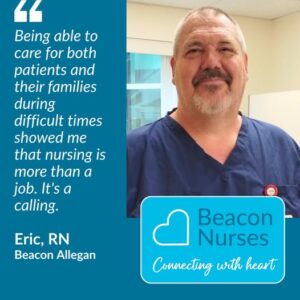
Eric Hamman, RN
Beacon Allegan
Eric Hamman spent years managing a car dealership before he became a nurse. He is still not entirely sure what pulled him toward healthcare. What he knows is that he was looking for more meaningful work, and he found it.
That was 29 years ago. He has spent all of them at the community hospital in Allegan, moving through critical care, the emergency department, surgery and now triage. He has never left.
The moment he knew came not in a dramatic clinical situation but when he realized he was not just helping a patient. He was helping the family sitting beside them. “Being able to care for both during difficult times showed me that nursing is more than a job. It’s a calling.”
And in a small community hospital like Beacon Allegan, those families come back. They find him in the hallway or the parking lot and say thank you for taking care of their grandfather, their grandmother, someone they loved. “Those moments stay with you,” he says. “That’s when you know the care you provided truly made a difference.”
For Eric, connecting with heart means caring for the patient and the family together. “Offering support, comfort and reassurance when they need it most.”
Outside the hospital he hunts and fishes. The outdoors resets him. His wife and son ground him. “They remind me what’s most important and give me the support I need to keep showing up and doing my best for my patients.”
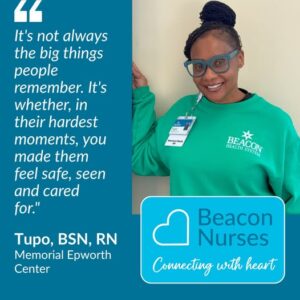
Tupo Chipala, BSN, RN
Memorial Epworth Center
When someone is in crisis, Tupo Chipala becomes their calm. It is, she says, what psychiatric nursing asks of you most.
She didn’t plan to become a psychiatric nurse. She needed a position that worked with her son’s childcare schedule and there was an opening. She never left. “Every day is different and I get to learn something new about people, their lives and how we can better support them.”
She grew up surrounded by nurses. Her mother was a nurse before Tupo was born. Four aunts followed the same path, including one who retired as a Dean at a nursing university. She watched her mother come home happy and chipper some days, exhausted on others, always talking about how meaningful it was to help even one person. “That always stayed with me.”
She knows she is in the right place when a patient who arrived agitated becomes calm and able to have a meaningful conversation. When someone feels safe enough to speak up and begin to participate in their own care. “Being present, listening and staying calm, especially in crisis, can truly change someone’s experience.”
She remembers a patient who was overjoyed by something small that staff helped provide upon discharge. A basic need met. But to that patient, it was everything. “It reminded me that dignity matters,” Tupo says. “We often focus on medications and treatment plans, but meeting basic needs and really seeing the person in front of you can have a huge impact.”
Her patients have made her better. “Most of them are brutally honest, and they teach you a lot about yourself. Instead of taking things personally, I’ve learned to reflect, grow and even laugh at myself.”
On the hard days she leans on her family, her team and her faith. Prayer, self-care and rest without guilt. Sometimes that means napping during a pedicure, taking a long bike ride or listening to an audiobook. “We celebrate wins together and talk through tough moments,” she says of her team. “We each have a sense of humor, so we laugh a whole lot.”
To anyone considering the nursing profession, she says, “It’s not always the big things people remember. It’s whether, in their hardest moments, you made them feel safe, seen and cared for.”
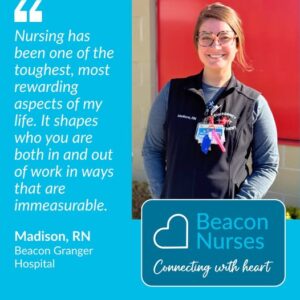
Madison Beggs, RN
Beacon Granger Hospital
Madison Beggs has never met a stranger. She will tell you that herself.
She spent years traveling the country, living in places like Vail, Colorado, working as a server and bartender, thriving in rooms full of people she had never met. She loves people. She loves conversation. She has always known that about herself. What took her longer to find was what to do with it.
The answer came in a Memorial Hospital emergency room bay. While transporting a patient on the Beacon Transport team, Madison watched a nurse working on a patient and felt something click. “I told myself I want to be like her when I grow up.” She was 26.
She went back to school through the Beacon Scholars program, earning her LPN and then her RN. During a nursing clinical, she spent a day with a patient who had recently been extubated in the ICU. She helped her detangle and braid her hair. The woman told her she felt like a new woman. “I still remember her name six years later. It solidified that I was on the right path and how important it is to care for humans as a whole.”
Madison has spent the last several years in the emergency room at Beacon Granger Hospital, where she understands something fundamental about the people who walk through her doors. “It usually isn’t on anyone’s bingo card to be seeing me.” So she makes it as easy as possible. She makes people laugh. She makes connections. She makes people feel heard. During a tornado watch, she had patients and staff seek shelter and she handed out certificates that read “I survived a tornado watch at BGH” after they were in the clear. Everyone left smiling.
Madison’s family, her husband Austin, fishing, boating and cooking are what bring Madison back to herself on the days when the work follows her home.
“If you think ‘I could never do what you do,’ I would encourage you to think again. Nursing has been one of the toughest, most rewarding aspects of my life. It shapes who you are both in and out of work in ways that are immeasurable.”
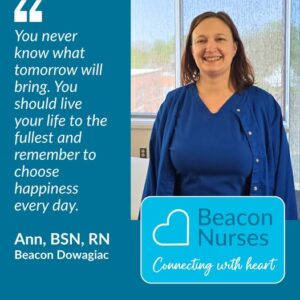
Ann Empson, BSN, RN
Beacon Dowagiac
Ann Empson says she had no idea God would choose her to become a nurse.
A woman in her life recognized something in Ann that Ann could not yet see in herself. She told her to become a CNA. If she loved it, the woman told her she’d make an amazing nurse. Ann loved it. What followed was a long line of mentors — people in the medical field and people who are not, who have shown her compassion and provided her with education, patience and guidance. “These incredible people have shown me how to become the best nurse I can possibly be.”
Seven months into her nursing role Beacon Dowagiac, she carries every one of those mentors with her. Ann has had many moments that confirmed she was in the right place, too many to count. “When I am able to make a difference in someone’s life, I feel fulfilled.”
There is one experience she returns to often. Years ago she had the privilege of caring for multiple members of the same family, walking beside them through the end of life. “This family made me a better nurse, friend and mother.”
For Ann, connecting with heart means reading the room. Some patients want jokes. Others want quiet. Some want their hand held. Others want space. “Being kind, caring, friendly and supportive helps patients feel secure, trusting and safe.” Meeting people where they are is everything.
Nursing has changed the way she sees the world. “You never know what tomorrow will bring,” she says. “You should live your life to the fullest and remember to choose happiness every day.” On the hard days that choice is what keeps her going. “Choosing happiness and spreading kindness keeps me motivated, grounded and inspired.”
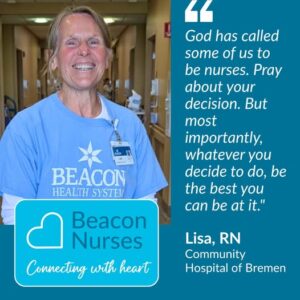
Lisa Eib, RN
Community Hospital of Bremen
Two of Lisa Eib’s children are named after patients she loved.
She cared for both of them early in her career. They were young. Their situations were serious. And she loved them the way nurses love the patients who stay with them long after a shift ends. When it came time to name their two oldest children, she knew exactly what those names would be. “I loved those kids,” she says.
She grew up watching her dad battle health issues and stepping in to help care for him. Nursing was never a question for her. It was a calling. Nearly 10 years into her work on the Med/Surg unit at Community Hospital of Bremen, she still feels it the same way. The moments that affirm it come when a challenge at work resolves well, or when a patient or family expresses gratitude. “Those are the moments that affirm my calling.”
For Lisa, connecting with heart is simple and clear. “Caring for the person, not the patient.” The older she gets, the more she sees everyone as equal. Her faith shapes everything. “We’re all equal at the foot of the cross, and if we want to be Jesus’ disciple, that is how we should view everyone as our equal.”
Her faith carries her through the hard days, too. “Jesus forgives me for the mistakes I make, and that includes when I just don’t do my best. That is my biggest stronghold.” Her husband listens when she needs to vent. Three of their four children have gone into healthcare, which means there is a lot of talk when the family gets together.
To anyone considering nursing, her advice is grounded in the same faith that guides her work. “God has called some of us to be nurses. Pray about your decision. But most importantly, whatever you decide to do, be the best you can be at it.”
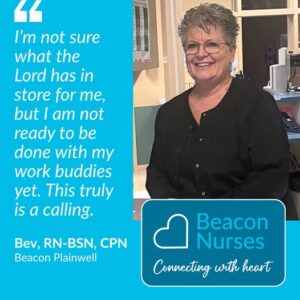
Beverly Post, BSN, RN, CPN
Beacon Plainwell
Beverly Post did not set out to change the world through nursing. She set out to be a wife and a mom.
She chose nursing because she could work part time and still be home for her family. She started as an LPN, became an RN four years later and settled in on the night shift at Beacon Plainwell. That was 43 years ago. She has never left and she has never wanted another shift.
Nursing school was a revelation for a young woman raised conservatively in private schools. The clinical world was, she says, quite shocking at times. But an instructor helped her find her footing and her faith. “I need to keep what happens at work, things I see and do, and leave it there.”
In 2011, Beverly lost her husband Kevin in a tragic work-related accident. Suddenly she was a widow with two of her four children still at home and a life that had to be rebuilt from the ground up. Her manager and her colleagues wrapped around her and gave her the time she needed. “I will forever be grateful to them,” she says. When the kids left for college and the Navy, she returned to full time. The unit that had always felt like home became something she could not imagine her life without.
She raised four children, working part time and PRN, adjusting her hours around school plays and soccer games and everything in between. Now they live all over the country, and she was recently blessed with her eighth grandchild. Outside the hospital, she tends her flowers, travels when she can and says camping is the best. “I’m not sure what the Lord has in store for me, but I want to spend more time traveling with friends and seeing my family.”
She plans to keep going. Her career has never been just a job. “This truly is a calling. You give so much of yourself to meet the demands of the patients, the fast pace of the ER, the stressors of family and death.”
The team she works with keeps her going. Every nurse brings something different. One is great with math. Another is lightning fast with an IV. One likes inserting nasogastric tubes. One never stops communicating. “Working together is everything. This makes the shift go smoothly and safely. But I am not ready to be done with my work buddies yet.”
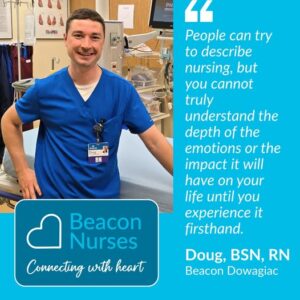
Doug White, BSN, RN
Beacon Dowagiac
A pastor walked into the emergency room one night and asked if he could bless Doug White’s hands for healing.
Doug had just come off one of the hardest shifts of his career. He felt exhausted and depleted. He even wondered if he had chosen the right path. The very next night, that pastor came in. “It was a deeply surreal moment,” Doug says. “Coming right after a shift that had tested my limits, it felt like a powerful sign that I was exactly where I was supposed to be, despite the hardships of the job. That experience stayed with me and continues to remind me of my purpose on difficult days.”
There have been other times when he has needed that reminder.
Early in his career, a patient came into the emergency room in severe distress. Doug did his best to comfort and reassure him the pain would be managed. But the patient was terrified, instinctively feeling that something was deeply wrong. The test results confirmed his fear. He passed away shortly after.
The patient’s parents later sent a thank-you card to the department, mentioning specifically the empathy and comfort Doug had provided during their son’s visit. “This experience was devastating, but it profoundly shaped my nursing career. It taught me to never minimize a patient’s symptoms, no matter how typical they may initially appear. I always honor a patient’s intuition, treating every presentation with the clinical gravity it deserves and remembering that behind every symptom is a human being trusting us with their life.”
Doug joined Beacon Dowagiac earlier this year. His colleagues joke that he is a local celebrity because patients request him by name and former patients stop him around town just to say hello and thank him. “Exceptional nursing goes beyond just checking off clinical tasks. It requires taking the time to truly understand the individual.”
Nursing has shaped the way Doug moves through the world outside the hospital. Within his circle of family and friends he has become a trusted voice for health concerns they might otherwise keep to themselves. And he has learned something that stays with him in every difficult moment, personal or professional. “Anger is often just a mask for underlying fear.”
His colleagues carry him through the hardest shifts. A moment of humor. Someone who knows his favorite snack. “These actions are far from trivial. They are tangible reminders that we are looking out for one another.”
To those considering nursing, his advice is hard won and heartfelt.
“Entering this field is akin to becoming a parent. People can try to describe nursing, but you cannot truly understand the depth of the emotions or the impact it will have on your life until you experience it firsthand.”
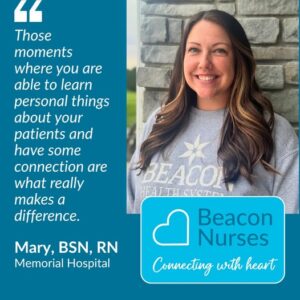
Mary Szczechowski, BSN, RN
Memorial Hospital
Mary Szczechowski believes that connecting with heart is done in the small moments.
She remembers a trauma patient from years ago who had sustained a serious leg injury. She sat with him, showing him the pictures of his leg at the time of the accident that were provided by his surgeon. He had a hard time accepting his injury and was in and out of the hospital several times after that admission. But in that moment, what he needed was not a clinical intervention. He needed someone to stay. “I was able to take some time with him when he needed it and give him a moment to grieve and process his injury,” she says.
In the 15 years she has spent at Memorial Hospital caring for orthopedic, neuro and trauma patients, she has learned that these moments matter. Learning something personal about a patient, sharing a brief connection, pausing long enough to really listen. These are the things that make a difference in a patient’s stay.
“Those moments where you are able to learn personal things about your patients and have some connection are what really makes a difference.”
Mary was inspired to become a nurse by her mother, who spent most of her career in home care. “She is the most selfless person I know, and she took pride in being a nurse and helping people.” That example has shaped every shift Mary has worked since. Every patient interaction is about making the most of each moment. Making eye contact. Listening to a story or a concern without rushing.
“Building rapport and gaining a patient’s trust can make all the difference, even with a more challenging patient situation.”
The team around her today on 8 South keeps her grounded in that purpose. Her nursing colleagues, nursing assistants, case managers, providers and a manager she describes as amazing — everyone lifts one another up when things get tough. To anyone considering nursing, Mary says it’s all about finding the right fit. “Find people who support and guide you in the right way. You do have the power to make a difference.”
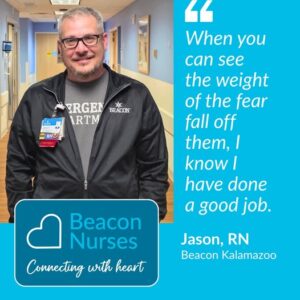
Jason Belt, RN
Beacon Kalamazoo
The patients Jason Belt remembers most are not the critical cases. They are the ones whose fear fills the room before he even says a word.
The people having the worst day of their lives who just need someone to sit with them and make everything feel less frightening. “When you can see the weight of the fear fall off them, I know I have done a good job.”
He remembers nursing moments like this one. A patient came in for something routine but was anxious about being in the hospital. Her daughter was with her. Jason found himself talking about nothing in particular — family, grandkids and easy ordinary conversation. By the time he left, both the patient and her daughter felt better. The daughter told him she could tell he really loved his job.
“It is days like that where I get to make them feel like they are getting the best care and they are in good hands.”
Jason did not always know he would end up here. He was searching for direction when he visited his grandfather in the hospital and watched his nurse move through the room, doing his work, pausing to talk, then excusing himself to see the next patient. When he left, Jason’s grandfather turned to him. “You could do that,” he said. “Why don’t you go to nursing school and get a career instead of just another job.” And so he did.
He has been a nurse for 17 years, the last six in the Emergency Department at Beacon Kalamazoo. Patients and families sometimes ask what made him choose this path. When he tells them, the response is almost always the same. “You can tell you really like your job, and your grandpa would be so proud,” they say.
Hearing that is when Jason knows he is exactly where he should be.
Still, there are hard days in the ED when he is pulled in every direction. “When I don’t get to spend as much time with patients, I feel like I am failing them,” he says. But he never stops trying.
He is honest about what awaits those who choose nursing. It is fast paced, ever changing and physically and mentally demanding. “But no matter how much you know, there’s always more to learn.” And that, to Jason, is exactly the point.
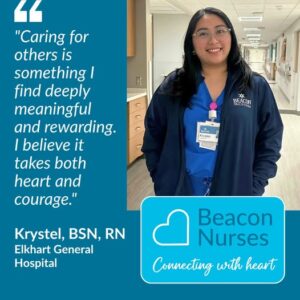
Krystel Reyes, BSN, RN
Elkhart General Hospital
She learned what nursing could be by watching her grandmother.
Krystel Reyes is originally from the Philippines. Her grandmother worked in the U.S. as a healthcare provider in a nursing home, and her example stayed with Krystel — dedication, compassion and daily choice to show up for those who needed care.
“Caring for others is something I find deeply meaningful and rewarding,” Krystel says. “I believe it takes both heart and courage.”
Early in her nursing career, Krystel cared for a premature newborn for many months. A bond formed between them as she watched him fight. Despite everything she and the team gave, the baby didn’t make it. She was caring for his family at the same time, supporting them through their grief while navigating her own. “That experience taught me how deeply nursing can impact you as a person. It also helped me understand the importance of resilience, while recognizing when to step back and seek support or guidance from others.”
Krystel joined Elkhart General Hospital earlier this year, bringing her nursing experience to the Flexible Acuity Unit. Connecting with heart, she says, means making patients feel seen, heard and valued. Being sick and hospitalized can make someone feel vulnerable, she says, and nurses are there to advocate, offer empathy and encouragement.
It also extends to colleagues. During a busy shift, when someone is overwhelmed, she steps in without being asked. “It’s not just about completing tasks, but about genuinely caring for one another as professionals.”
Nursing has given her a deeper appreciation for both life and death. “It has taught me to value each moment and the people around me,” she says. Her family keeps her grounded. “Even though we are miles apart, I continue to feel their unwavering support in every decision and path I take.”
To anyone considering a nursing career, she says this: “Pursue it wholeheartedly. With dedication and genuine passion for helping others, you can overcome obstacles and achieve your goals. Staying focused on your purpose will carry you through even the most difficult moments.”
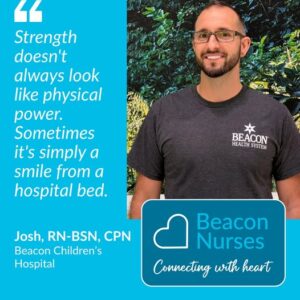
Josh Flatt, BSN, RN, CPN
Beacon Children’s Hospital
They are the bravest people Josh Flatt has ever met. And most of them are still in grade school.
In nine years as a pediatric nurse at Beacon Children’s Hospital, Josh has cared for children who face things no child should have to face. His heart lives in pediatric oncology, where he follows kids through their entire treatment journey, shift after shift, appointment after appointment.
“These kids go through so much at such a young age, yet they remain the bravest real-life superheroes I’ve ever met,” he says. “Seeing their resilience taught me that strength doesn’t always look like physical power. Sometimes it’s simply a smile from a hospital bed.”
Josh came to nursing through his father, who studied to become a certified medical assistant when Josh was young. He watched him pore over textbooks, absorbed by the dedication it took, and it stayed with him. He came to nursing after years as a medical assistant, which means by the time he walked onto a pediatric unit he already understood something essential: patients need someone in their corner.
He has never had a single lightning bolt moment that confirmed he was in the right place. It builds over time. A child smiling on one of the worst days of their life. A family expressing gratitude for the care the team provided. “Those moments serve as a constant reminder of why this work matters.”
Connecting with heart, to Josh, means making sure every patient and family feels truly seen. “Not just treated,” he says. It means understanding that every person processes difficult times differently and choosing, intentionally, to meet them where they are.
Eighteen years in healthcare have deepened his ability to recognize what he calls the invisible burdens people carry. He notices things others might miss. He loves more intentionally because of it. Outside the hospital, time outdoors and quality time with his family keep his mind and heart stronger than the stress of the job.
“Come into it with an open heart,” he says to anyone considering nursing. “The science and clinical skills can be taught. But the soul of nursing is human connection.”
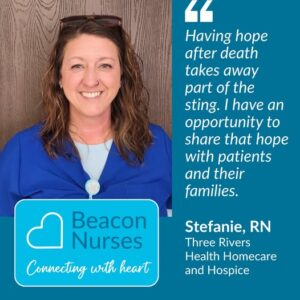
Stefanie Patrick, RN
Three Rivers Health Homecare and Hospice
There was a patient who just wanted to fish one more time.
He was an avid fisherman, and as a hospice nurse, Stefanie Patrick understood that some wishes are not just wishes. They are the whole point. She arranged the outing, got him on a boat and put a rod in his hands one last time. His family told her afterward that he talked about it for days. For Stefanie, that is what connecting with heart looks like.
Not in a clinical moment, but in a fishing boat, on an ordinary afternoon, giving someone the one thing they needed most.
Eight years into her work as a Home Health and Hospice Case Manager at Three Rivers Health, Stefanie has come to understand something that is hard to explain to people outside this work. Helping someone die with dignity and comfort is not a sad job. It is a sacred one. “You are not only a nurse,” she says, “but you become part of their family.”
She grew up in this community. The patients she cares for are often the parents, grandparents or relatives of people she has known her whole life. “They find comfort in seeing a familiar face,” she says. Hospice has taught her to pay attention to the things that matter most at the end of a life. A smile. Sunshine. A little more time.
She came to nursing through her family. Her aunts were nurses. Her father was an EMT. She grew up listening to their stories and admiring the way they showed up for people in need. But it wasn’t until she found her way to hospice that everything fell into place. “Helping people and their families in the worst moments of their lives is so rewarding,” she says. “Doing everything I can to make sure your loved one dies with dignity and comfort.”
Her faith carries her through the hardest days. “Having hope after death takes away some of the sting,” she says. “I have an opportunity to share that hope with patients and their families.” Her husband also carries her. He knows when she needs a hug and when she just needs someone to sit beside her.
To anyone thinking about becoming a nurse, Stefanie’s answer is simple. “Do it. There are so many different paths you can take. You will never get bored.”
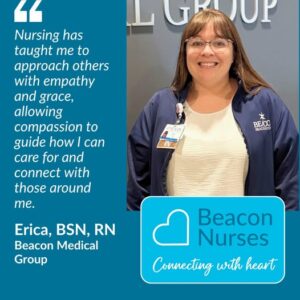
Erica Horvath, BSN, RN
Beacon Medical Group
When Erica Horvath’s family gathered at her grandfather’s bedside, they had just received the news no family wants to hear. There were no further interventions. Nothing more medicine could do.
A nurse entered the room and began caring for the family with extraordinary grace and compassion. He made sure her grandmother, keeping vigil at her husband’s side, had warm blankets, food and water. He tended to the family the way he tended to the patient. That experience, Erica says, she cannot put into words.
She had been working in healthcare for seven years as a certified medical assistant. Colleagues and managers had encouraged her to go back to school for nursing. But fear held her back. Fear of failure. Fear of whether she could manage nursing school while being a wife and a mother. Watching that nurse move through her family’s grief with such quiet purpose, those fears began to fade. By that summer she was back in school.
Nearly eight years into her role as Group Practice Manager for Beacon Medical Group’s Education and Float Team in Indiana and Michigan, she still carries that nurse’s example with her.
One patient she will never forget came to her not in a hospital room but in the simple act of scheduling an appointment. His fear was palpable. She took her time with him, walked him through the process and made sure he felt supported. After his visit, he sought her out to thank her personally and ask for a hug. “That simple gesture of gratitude is something I will never forget. In that moment, the patient affirmed and validated exactly why I chose to become a nurse.”
Erica says connecting with heart lives in the smallest moments. Eye contact. Remembering something important about a patient. Being truly present. Showing up as your authentic self, without being guarded, and allowing genuine compassion to guide every interaction. “Above all, nursing has taught me to approach others with empathy and grace, allowing compassion to guide how I can care for and connect with those around me.”
To anyone considering this path, she offers both encouragement and an open hand. “I would encourage them to do it. And I would ask, ‘How can I help support you through your journey?'”
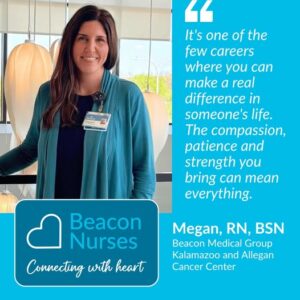
Megan Bridgeman, BSN, RN
Beacon Medical Group Kalamazoo and Allegan Cancer Center
Megan Bridgeman was 18 years old when her grandmother died unexpectedly in a hospital. Despite her grief, the nurses she watched caring for her grandmother showed her something she has never forgotten — how much it matters to have the right person beside you in the hardest moments of your life.
“Her loss created a sense of purpose for me. Instead of just being an extremely painful event in my life, it became something I carried forward.”
Today, Megan is the Clinical Support Manager for the Kalamazoo and Allegan Cancer Center, where she has spent her 25-year nursing career with what is now Beacon. Leadership, she has learned, is just another form of nursing. “Helping staff grow, mentoring newer nurses and creating a supportive environment is just as important and meaningful to me as bedside care because you’re multiplying that impact through others.”
Earlier in her career, Megan spent time as a hospice nurse. One patient she will never forget was a young, newly married man with terminal cancer. Despite his diagnosis, he was full of life and positive energy. He told her she had a gift for connecting with people and that even in the hardest moments, life is still worth living. He told her not to wait for the perfect time, to laugh, make memories and enjoy the people around her while she could.
Life isn’t about how much time you have, he said, it’s about what you do with it.
She thinks about him when she watches her team at the Cancer Center. Nurses pooling money to buy tickets to a sporting event for a patient who couldn’t afford them. Birthday celebrations set up in treatment rooms. Uber rides arranged so patients can make their appointments.
And then there was the nurse who purchased a Sasquatch costume, went outside on April Fool’s Day and ran past the treatment windows just to get some smiles and laughs from the patients. “I truly work with the most compassionate group of people,” Megan says.
Nursing has sharpened her sense of what matters. Small inconveniences fade, and relationships, health and time carry more weight. To those who are considering nursing, she says, “Do it. It’s one of the few careers where you can make a real difference in someone’s life. The compassion, patience and strength you bring can mean everything, not just to patients, but to their families, too.”
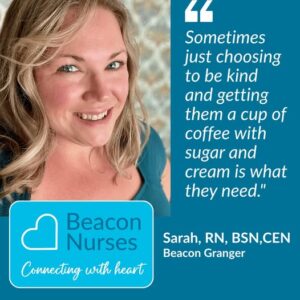
Sarah Hickle, BSN, RN, CEN
Beacon Granger
The emergency room changes you. Not always in the ways people might expect.
Sarah Hickle has put a lot of thought into how to explain this. Nearly 20 years of emergency nursing teaches you to function in chaos, to stay calm when everything around you is not, she says. It also builds a certain emotional distance that helps nurses survive the hardest shifts.
That distance can look like detachment to the people who love them. “But that isn’t the case,” she says. “It’s more an acceptance that bad things do happen. They need to be handled, and then life moves on.” When crisis becomes part of your everyday reality, you learn to process it differently than most people have to.
But the caring and empathy never go away.
She knew emergency nursing was her calling between her junior and senior year of nursing school, when she found herself in an Indianapolis ER during a cardiac arrest. She had never been in a critical care situation. She felt anxiety, calm and focus all at once. She watched the organized chaos, listened carefully and did what she could within her scope.
“After that,” she says, “I knew the ER was for me.”
Now a nurse at Beacon Granger, Sarah understands that people arrive at the ER carrying far more than their symptoms. They carry their choices, their circumstances, their fears. But as a nurse, she does not judge any of it. “Sometimes just choosing to be kind and getting them a cup of coffee with sugar and cream is what they need.”
Connecting with heart, to Sarah, means meeting patients where their anxiety lives. Much of the fear people bring into an emergency room comes from not understanding what is happening or why they are waiting. When she takes the time to explain things in a way a patient can understand, she can watch the tension leave their body. “Once the unknown is understood, patients start to trust and that anxiety dissipates.”
Burnout is real in nursing, but Sarah has also learned that slowing down and being fully present with a patient and their family can be just as meaningful as the moments of dramatic intervention. The nurses who have become her closest friends keep her grounded. “I would be lost in this world without them.”
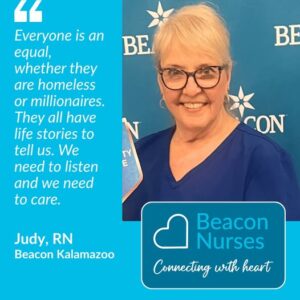
Judith Ann Looper, RN
Beacon Kalamazoo
Forty-nine years.
That is how long Judith Ann Looper has been a cardiac nurse at Beacon Kalamazoo. She was playing nurse and doctor with her friends when many of her future colleagues were still being born. She wanted a career that was dignified, that would transform her own life while changing the lives of others.
Forty-nine years later, it has done exactly that.
Her most vivid memory takes her back to the Coronary Care Unit early in her career. As a child, Judy had been shocked by electricity and never quite gotten over it. Then came a patient who kept going into cardiac arrest, over and over throughout the day. This was the 1970s, and there were no hands-off pads. Every time he arrested, she had to shock him with the paddles herself. “I was so scared. But he wanted to live, so we continued the treatment.”
He lived and received one of the earliest implantable defibrillators. Years later she saw him again. She remembers how amazing he looked and what it meant to be able to give him a hug. “My fear of electricity is now gone,” she says. “Well, almost.”
For Judy, connecting with heart means answering every question a frightened family member asks. Making sure people understand exactly what is happening and what to expect. And mentoring the newer nurses who are just finding their footing, the way someone once helped her find hers. “My new colleagues and I laugh as I share my early memories of nursing.”
Nursing has taught her that people are people. “Everyone is an equal, whether they are homeless or millionaires. They all have life stories to tell us, and we need to listen. They are someone’s mother, sister, wife, father, brother, husband. And we need to care.”
Her colleagues keep her grounded. The laughter, the shared stories, the moments when someone needs a shoulder and finds one.
“There will be days you want to quit. Take a deep breath and persevere with confidence,” she says to future nurses. “You are healing humanity, one heartbeat at a time.”
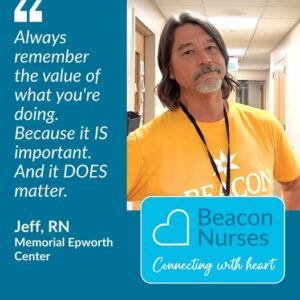
Jeff Norton, RN
Memorial Epworth Center
Jeff Norton did not come to psychiatric nursing looking for a calling. He came to it looking for a job.
He knew himself well enough to know he was not cut out for an office and would never survive in sales. Nursing made practical sense. Good job security, a variety of specialties to choose from and the freedom to go just about anywhere. What he did not count on was an instructor who saw something in him before he saw it in himself.
His clinical time was spent on a long-term unit housing some of the most seriously ill psychiatric patients he had ever encountered. One had committed an act of violence that had devastated his entire family. And yet, standing in that unit, Jeff felt something unexpected. Calm. At home.
At the end of the rotation, the instructor pulled him aside. She told him he would make an excellent psych nurse. He chuckled, thanked her and told her he had other plans. She encouraged him to give it serious thought.
A few years later, an opportunity in behavioral health opened up. He took it. That was 15 years ago. He has never looked back.
“Psych nursing is where my heart is,” he says. “Mental illness and substance abuse can be just as devastating to a person and their family as cancer or any other fatal or chronic disease.” For Jeff, connection is everything in this work. Listening. Showing patients he cares. Meeting them where they are. “Offering some warm vibes,” as he puts it, without engaging in needless power struggles. Watching a patient stabilize after a devastating episode and hearing the sincere gratitude of their family. Those are the moments that keep him going.
He has spent the last six of his 15 years at Memorial Epworth Center in South Bend on the night shift, where the work is quieter but no less important.
To anyone considering nursing, his advice is both an invitation and a reality check. “Go for it. But keep in mind that caring is not enough. You will need to prioritize, organize and strategize.” He pauses on what matters most. “Always remember the value of what you’re doing. Because it IS important. And it DOES matter.”
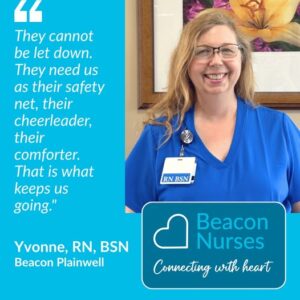
Yvonne Vanhorn, BSN, RN
Beacon Plainwell
Long before she had a nursing license, Yvonne Vanhorn was already practicing.
She was the neighborhood veterinarian as a little girl. She helped care for her grandmother in her final years. She assisted a family member with a disability. By the time she officially became a nurse, she had already spent a lifetime learning how to care for people in need.
The nurse who shaped her most was not a professor or a clinical instructor. It was a woman named Mary, who sat with Yvonne when her grandmother passed away and simply listened. “The most important thing she did was listen to me as I grieved,” Yvonne says. “I will never forget her.” She determined then and there to be that kind of nurse for others.
Six years into her work at Beacon Plainwell’s Long-Term Acute Care Unit, she carries that intention into every room.
One patient she will never forget came to her gravely ill, her body failing in ways that made communication nearly impossible. She was on a ventilator. Anxious. In pain. Extraordinarily difficult to reach. ‘It was extremely hard to read her lips,’ Yvonne recalls. She gave the woman as much of her time as she possibly could, offering a bed bath, presence and patience, and they built a trust that mattered. The patient passed away on Yvonne’s shift. “Seeing someone suffer so much really impacted me. It made me want to help her as much as I possibly could.”
For Yvonne, connecting with heart happens in the smallest moments. A wave as you pass a room. A smile. A joke that acknowledges a patient’s humanity. Seeing the person, not the diagnosis. She witnesses it every day in the colleagues around her and is deeply proud of what they do together.
Being a nurse does not end when you clock out. She keeps an eye on the people around her wherever she goes, always watching for someone who might need her.
“They cannot be let down,” she says. “They need us as their safety net, their cheerleader, their comforter. That is what keeps us going.”
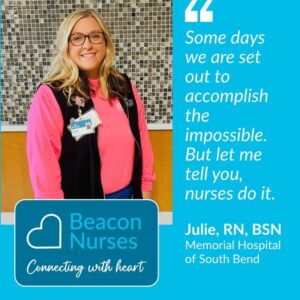
Julie Miller, BSN, RN
Memorial Hospital of South Bend
The difficult conversation. The medically fragile patient. The situation with no clean resolution. For Julie Miller, that is exactly where she wants to be and where she was meant to be.
“I love to find resolutions and dig deep into fixing problems,” she says. “It takes time, patience and compassion to sit with our patients and understand their concerns and fears and maybe why they are in the state they are currently.”
As charge nurse on 7 South at Memorial Hospital, Julie has spent nearly 10 years being what she calls the glue. The person who coordinates, advocates, digs in and stays. She started at Memorial as a patient care assistant while still in nursing school, shaped by the nurses around her who made her feel safe enough to keep going. Some of those same nurses are still beside her today.
The patients she carries with her longest are not always the ones with the good outcomes. Sitting with someone in the final stages of life and then clocking out and going home. That is one of the quiet burdens of this profession that most people never see. “We pick up and continue on, not always allowing ourselves to process the emotion that comes with the job.” It has taken Julie the better part of a decade to find her way through that.
Connecting with heart means seeing the person behind the diagnosis. Understanding their story. Not just treating what brought them in, but caring about why. “Those individuals who impact a patient on a different level are those connecting with heart.”
Her team keeps her grounded. She leads them every shift and means it when she says she works with some of the finest people she has ever known. And to anyone considering nursing, Julie is honest about what they are stepping into.
“The pace is fast and the workload is not easy. Some days we are set out to accomplish the impossible,” she says. “But let me tell you — nurses do it. You can do anything for 12 hours. And the care you provided to someone in need outweighs the hard every single time.”
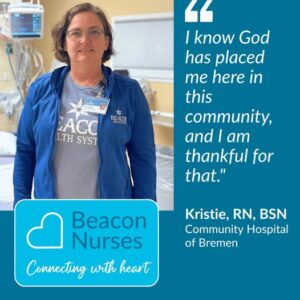
Kristie Ross, BSN, RN
Community Hospital of Bremen
After one of the hardest nights of her career, Kristie Ross was sitting on her couch watching television with her husband when the tears came out of nowhere. He asked what was wrong. She could barely get the words out.
“He never even got a Tylenol.”
Four nurses had fought through an entire shift to save a man’s life. They did everything medicine asked of them, but the patient didn’t make it. And somewhere in the desperate hours of that night, no one had stopped to ask if he was in pain. That realization has never left her. “I still well up thinking about it,” she says. “Lesson learned. I always address pain and comfort. Every single patient.”
That is what it means to be a nurse in a rural emergency room, where anything can walk through the doors. Farm accidents. Heart attacks. Strokes. Kristie has worked at Community Hospital of Bremen since 2019, and she is certain she is exactly where she belongs. “I know God has placed me here in this community, and I am thankful for that.”
For Kristie, connecting with heart means being fully present. Pausing. Listening. Hearing what a frightened patient or family member is trying to say. It means recognizing that an oxygen tube can feel terrifying to someone who has never seen one. When a frightened parent is climbing into the back of an ambulance not knowing what comes next, Kristie quietly slips something to eat into their bag. “Simple things can mean the world to someone on their worst day.”
Nursing has taught her to hold every day a little more carefully. “I have seen people survive the most traumatic and devastating things,” she says, “and people succumb to the most simplest of things.”
She finds her peace at home among her garden, her yard and her chickens — different breeds, chosen for the colors of their eggs. Her doctor told her she needed a hobby. She became, as she proudly calls herself, a chicken lady.
Her advice for anyone thinking about nursing is the same mantra that carried her through years of night classes, one degree at a time. “Do it. Take it as far as you want to go. And just keep swimming.”
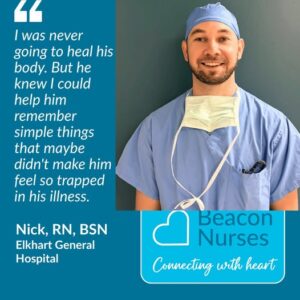
Nick, BSN, RN
Elkhart General Hospital
He was a young nurse, still finding his footing, when a patient stopped him cold.
The man was living with paralysis. Nick had shared his own story with him, the spring break trip to Miami, the dive into a sandbar off the coast, the fractured C5 vertebra, the months on campus in a cervical collar, the humiliation and the quiet realization that his life had just changed direction.
The patient listened. Then he made a request that Nick has never forgotten. He asked Nick to go home that night, walk through the grass barefoot and come back the next day to describe how it felt.
“Seemed like a weird request at the time to a young nurse,” Nick says now. But he understood. “I was never going to heal his body. But he knew I could help him remember in his mind simple things that maybe didn’t make him feel so trapped in his illness.” A subtle way, Nick says, of reminding him to stay empathetic.
Nick did not set out to become the nurse he is today at Elkhart General Hospital. He wanted to play soccer and baseball, always just good enough to make the team. But the dive into that sandbar changed everything, opening his eyes to the complexity of the human body and to a question he could not shake. Why was he lucky when others weren’t?
He transferred schools and began studying nursing. “This encouraged me to listen more intently to God’s calling in my life.”
He started in critical care, where a team of colleagues, preceptors and educators shaped him. COVID hit eight months in. The days were long and the learning was fast, but he was exactly where he needed to be. He has since moved to the cardiovascular operating room. “The trust these patients and their families put in your hands as you take them from pre-op, through the halls to a huge room packed with blue sterility and cold instruments is insane. Sometimes I think to myself, “Who let you of all people do this?”
He has held an iPad for a grandfather struggling to breathe so the man could see his grandchildren’s Halloween costumes, only to come back on shift to find him gone. He has watched surgeons sew every stitch knowing it mattered. He has seen families broken by grief and patients who defied every odd. “Sometimes in this crazy world it seems like there is so little regard for human life and dignity. Working in health care as a nurse reaffirms that there is value in every life.”
That is what keeps Nick grounded. Every day he walks into that hospital, he is doing work that matters. “Keep putting yourself in positions where you can learn and grow,” he says to anyone considering the profession. “It is worth every bit of it.”
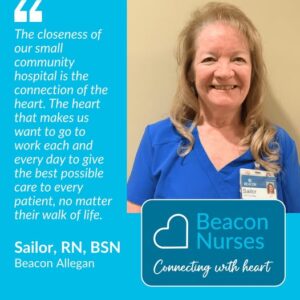
Sailor Dobbins, BSN, RN
Beacon Allegan
She has been there for the first breath. And she has been there for the last.
In 35 years of nursing at Beacon Allegan, Sailor Dobbins has held the hands of the newly born and the quietly departing. She has cared for grandparents, their children and their grandchildren’s children. She has watched bonds grow across decades, across generations, across some of the most profound moments a human being will ever experience.
“When families come back to visit me, to share stories with me, to see me during the holidays,” she says, “it makes all the sad times worth it.”
Sailor has worn many hats at Beacon Allegan, including med-surg nurse, labor and delivery nurse, float nurse and now chemotherapy nurse, where she walks alongside patients through one of the scariest journeys of their lives. Her first words to a new patient say everything about who she is. “We can get you through your chemotherapy journey. It will be filled with highs and lows, but together our team can get you through it one day at a time.”
She chose Beacon Allegan for its small, family-like community and has never left. That closeness is, to her, the very definition of connecting with heart. “The closeness of our small community hospital is the connection of the heart. The heart that makes us want to go to work each and every day to give the best possible care to every patient, no matter their walk of life.”
The hardest part of chemotherapy nursing is losing a patient. “You become so close to them and their families. It is truly heartbreaking.” When a patient passes, the entire unit gathers in support, because the loss belongs to everyone who cared for them.
But Sailor keeps coming back. For the teaching. For the holding. For the generations of faces she has come to know and love. “I want to be there,” she says simply, “holding their hand through it. That is when I am doing exactly what I was meant to do.”
Join our team and become a Beacon nurse
Nurses play a vital role in patient care and treatment across Beacon Health System. We’re always looking for compassionate nurses who are dedicated to delivering exceptional care and who want to make a difference for patients and families. We value their commitment to serving others and recognize the important role they play every day. We’re always seeking talented professionals who share our mission and want to build their careers at Beacon. Learn more or apply for a nursing position today.