Record-setting powerlifter prepares for competition after hip replacement at Beacon Bone & Joint
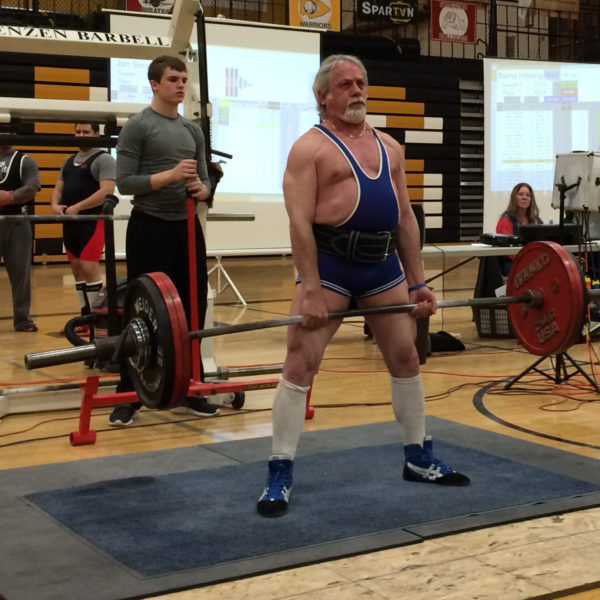
Jon Smoker, 2014
At 79, Jon Smoker is still chasing records.
“I got my first weight set when I was 16,” Jon said. “I did my first competition in 1972, and I never wanted to stop.”
More than six decades later, he still trains regularly, competes nationally and holds multiple American and world records in powerlifting. Along the way, he added other passions, including golf and water aerobics, to help him stay strong and healthy.
When he turns 80 in February 2027, he will pursue four world records in his new age division.
But a few years ago, the sport he loved began taking a toll on his body.
Severe hip pain caused by arthritis and avascular necrosis nearly brought his lifting career to an end. After anterior hip replacement surgery in February 2026 at Beacon Bone & Joint Specialists, he’s back in the gym and preparing to chase new records.
When hip pain threatened his lifting career
Jon traces the beginning of his hip problems to 2020. After setting a world record in his age group with a 400-pound deadlift, he played a round of golf the next day. He also resumed his longtime squat routine, a training program he had used for years. Jon had lingering aches and pains from the competition, but he pressed on.
A week after the competition, Jon was back in the gym when he noticed something was really wrong. “Not to blame that squat routine,” Jon said, “but that was the straw that broke the camel’s back.”
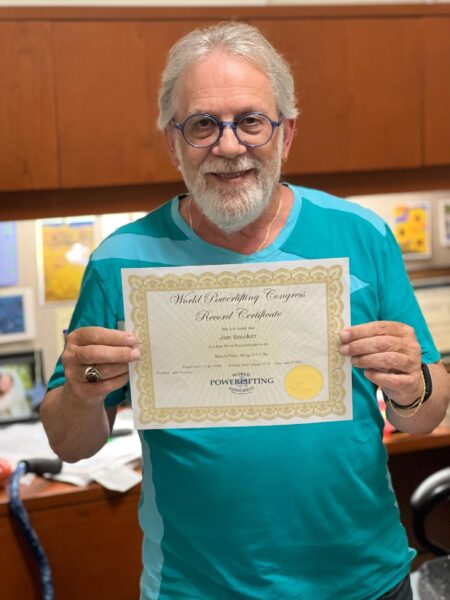
Jon Smoker with his 2022 World Powerlifing Congress Bench Press record of 216 pounds for the 75–79 age group, 165 lb. class.
The pain in his left hip felt different from the normal soreness that comes with competing. At first, he tried to push through it, but it gradually worsened. Climbing stairs became difficult, his walking slowed and he eventually relied on a cane to get around.
“It got to where I couldn’t ignore it anymore,” he said. An X-ray revealed severe damage to his hip. The cushioning in the joint was gone, and the bone was beginning to deteriorate.
Cortisone injections weren’t working, his pain worsened and his strength declined. He was still breaking world records, but Jon knew where things were going. “I read the handwriting on the wall,” he said.
By 2024, competing with weight on his hip was coming to an end. He competed in December of that year and squatted 241 pounds, five more pounds than his world record set in 2023. This time, it didn’t feel right, so he took some time off from squats and focused on the bench press.
When he started training squats again in February of 2025, he knew his hip couldn’t support his old weight limits. His big question was whether his weightlifting career was over.
Finding confidence in hip replacement surgery
For someone who had spent a lifetime in motion, the thought of hip replacement surgery was difficult.
Jon had heard plenty of stories about people who struggled after joint replacement procedures. He worried about losing mobility and wondered whether he would ever return to competitive lifting. He wondered how long his new hip would last before he needed a replacement. His brother was 97, after all, so Jon had good reason to believe he could live another 20 years or more.

Ryan O’Rourke, MD
Jon had done his research to find the right care. He wanted local care so physical therapy would be easier to access. Most importantly, Jon wanted someone with a good reputation. He first met with Heather Saffel, MD, a sports medicine specialist with Beacon Bone & Joint Specialists, in January 2026. They talked through his diagnosis, his preference for staying within the Beacon Health System so billing would go smoothly, his weightlifting goals and his desire for surgery to happen as soon as possible. She recommended orthopedic surgeon Ryan O’Rourke, MD, someone who checked all the boxes for Jon. After Jon read Dr. O’Rourke’s bio online and learned more about his experience, he felt ready to meet his surgeon.
With Dr. O’Rourke, Jon found the answers and confidence he needed to move forward.
“Jon was a great candidate for hip replacement surgery given his level of severe arthritis and avascular necrosis,” said Dr. O’Rourke. “There was no remaining cartilage, and the head of his femur was collapsing as a result of poor blood flow to the bone. His pain was affecting his hobbies and quality of life. Patients who meet this level of pain and disability with corresponding X-rays tend to have excellent outcomes with hip replacement surgery.”
After reviewing imaging and discussing his options, hip replacement specialist Dr. O’Rourke helped Jon understand what would happen if the condition continued to progress. Without surgery, Jon knew his mobility would likely keep declining. “Dr. O’Rourke was very thorough,” Jon said. “He showed me an X-ray, and he said, ‘You see that dark stuff right there in that bone? That’s necrosis.’”
Understanding avascular necrosis
Jon’s diagnosis was avascular necrosis, also called osteonecrosis. The condition occurs when bone tissue loses its blood supply and begins to die. Over time, the bone can weaken and collapse. The process can take months to years.
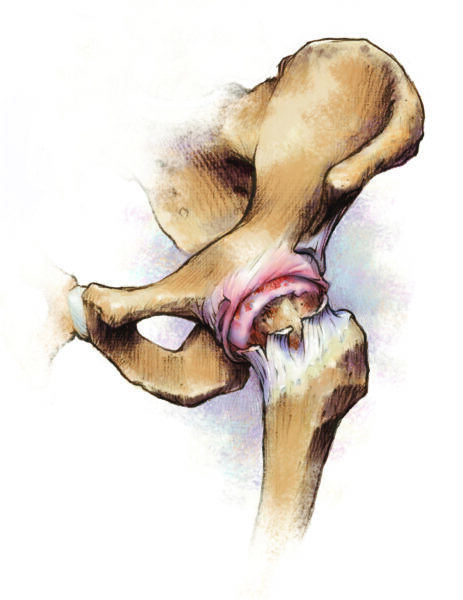
Diseased hip
Dr. O’Rourke explained to Jon that his hip would slowly dry out and crumble.
“Jon was a great candidate for anterior hip replacement given his lower-extremity powerlifting hobbies that might not be safely done after other traditional approaches,” said Dr. O’Rourke. “With the advances made in hip replacement surgery — from approaches, implants and technique — people definitely recover more quickly and return to a more active lifestyle.”
According to Dr. O’Rourke, the anterior approach offers a muscle-sparing technique that allows for quicker recovery and is also a more stable approach, significantly reducing the risk of hip dislocation and instability. Some individual factors may mean a patient is not a candidate for this approach, but in general, Dr. O’Rourke feels that most patients qualify.
According to Dr. O’Rourke, modern implants are extremely durable and can withstand the rigors of very active lifestyles and numerous forms of exercise and training. Most people can expect their hip replacement to last about 25 to 30 years before they need a revision.
After some detailed explanation, Dr. O’Rourke asked Jon, “So, you want to do this?” Jon could see the writing on the wall: He used one cane now, and without treatment he’d eventually use two canes, then a walker, and finally a wheelchair.
“We have to do this,” Jon remembered thinking.
Dr. O’Rourke scheduled Jon’s anterior total hip replacement for February 2026.
Recovery after hip replacement exceeded expectations
What happened after surgery surprised Jon. Like a lot of patients, Jon worried that hip replacement meant giving up the activities he loved. But the goal with hip replacement is the opposite. A successful hip replacement can relieve pain, restore function and help patients return to the activities they enjoy.
Jon was up and walking the same day as surgery and returned home after only one night in the hospital. More importantly, the deep joint pain that had limited him for years was gone.
“The evening after surgery, I was on cloud nine,” Jon said. “I was home and I had no pain where the joint had been hurting. I only had mild soreness at the incision site and a little ice helped with that.” After a few days, Jon was doing bodyweight squats.
Years of staying active helped prepare Jon for recovery. Before surgery, he was still participating in water aerobics and strength training. He listened to Dr. O’Rourke and used a walker for a week or two, then graduated to a cane. After about four weeks, he was walking on his own without aid.
“Jon did extremely well after his hip replacement,” said Dr. O’Rourke, “and I think it goes to show that people can do amazing things even after joint replacement surgery. I wish Jon the best of luck in his next series of power lifting competitions.”
When he began physical therapy, his care team quickly realized his goals extended beyond everyday mobility.
He didn’t just want to walk comfortably again. He wanted to compete.
Back to the platform
When Jon turns 80 in February 2027, there are four world records held by a Russian competitor that he wants to beat. “I can get them right now at my next competition in September,” Jon said. “But because I want those records when I turn 80, I’m going to take the next competition easy. I have bigger fish to fry.” Russian powerlifters and athletes have historically set some of the highest benchmarks in strength sports, so beating those records is a testament to extraordinary dedication, discipline and talent.
What does Jon mean by taking it easy? “I’ll start with a 200-pound squat and see how I feel from there.” His old world record is 235 pounds, which he says feels good and solid in training.
Living without pain
Recovery has been so good for Jon that at times he finds it hard to comprehend just how good it’s been. After driving back from visiting his daughter two hours away, he realized his hip didn’t hurt the entire drive. Then he started thinking about how he used to rotate three over-the-counter pain medications. “All of those have subtle side effects when you take them regularly,” Jon said. “I was able to stop taking them and found I felt better overall.”
Jon has some advice for anyone considering a hip replacement: “Get in as good a shape as possible, that makes a big difference. Do the therapy and don’t lie around. Keep moving and do the physical therapy work.”
Today, Jon focuses less on his hip and more on enjoying life. Whether he’s spending time with family, staying active or tackling everyday tasks without pain, he appreciates the freedom that comes with moving comfortably again. Looking back, he says choosing hip replacement surgery was one of the best decisions he could have made for his health and quality of life.